
Quick answer: Choose the Google Data Analytics Professional Certificate if you are new to data cleaning, spreadsheets, SQL, Python and visualization. Choose the Google Advanced Data Analytics Professional Certificate if you already have those foundations and want statistical inference, regression and machine learning. Google describes the advanced program as suitable for graduates of the foundational certificate or learners with equivalent experience. You do not have to buy both automatically.
Program details checked against official Coursera listings on 24 October 2026. Pricing, access and course lists can vary by location and change over time.
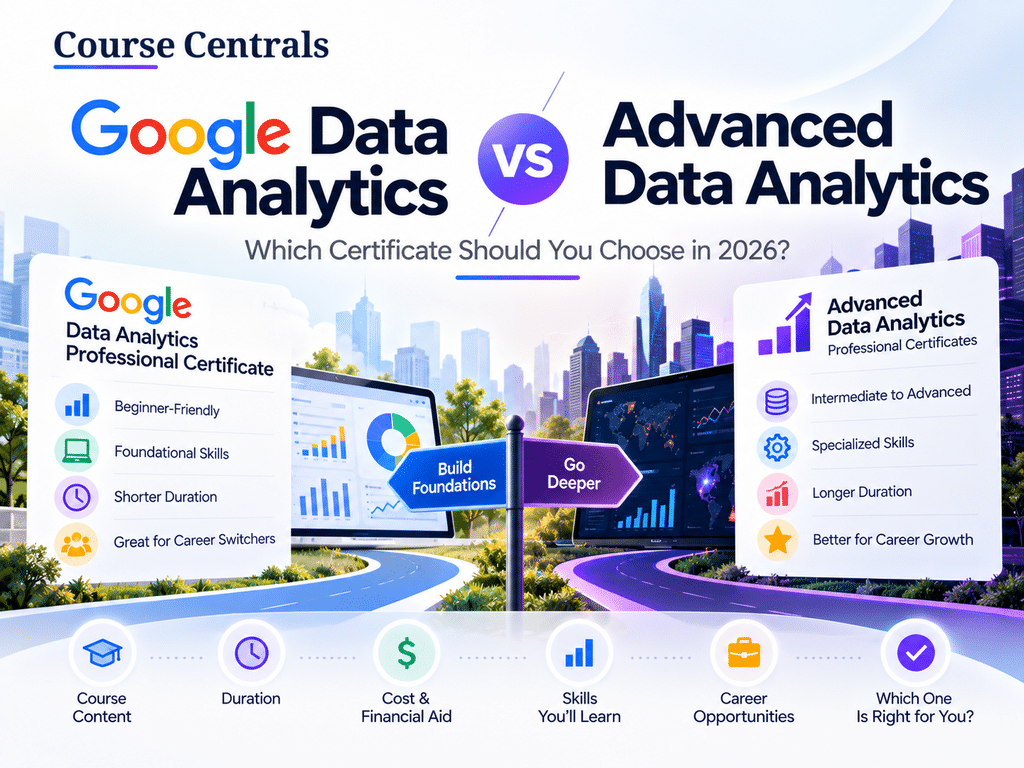
Google Data Analytics vs Advanced Data Analytics at a glance
| Decision factor | Google Data Analytics | Google Advanced Data Analytics |
|---|---|---|
| Best for | Beginners and career changers | Analysts ready for deeper statistical and predictive work |
| Provider and platform | Google on Coursera | Google on Coursera |
| Current course count | 9 courses | 7 courses |
| Level | Beginner, no degree or prior experience required | Advanced, foundational analytics knowledge expected |
| Key skills | Spreadsheets, SQL, Python, Tableau, data cleaning, presentation | Python, statistical inference, regression, machine learning, model evaluation |
| Projects | Case study for an entry-level portfolio | Advanced analytics capstone with modelling |
| Provider’s study estimate | About 6 months at 10 hours per week | About 6 months at 10 hours per week |
| Credential | Shareable professional certificate after required completion | Shareable professional certificate after required completion |
What changed in the foundational certificate in 2026?
The current Coursera listing shows nine courses, including Introduction to Data Analysis Using Python and an AI-assisted job-search course. Its FAQ explicitly states that the current curriculum teaches Python, not R. However, some residual skill tags and individual course descriptions on the same listing still mention R. Treat the numbered curriculum and FAQ as the more relevant starting point, and verify the course list displayed for your region before enrolling. Older reviews describing an eight-course, R-focused track may not match the current programme.
This matters if you were planning to skip the beginner certificate solely because you wanted Python. The current foundation includes Python, but it is still a broader introduction to the data-analysis workflow rather than an advanced data-science qualification.
What you learn in each certificate
Foundational Google Data Analytics: understand the full analysis workflow
You learn to define business questions, collect and clean data, query databases with SQL, analyse spreadsheets, write introductory Python, build Tableau visualisations and communicate findings. The case-study component can become the beginning of a portfolio, provided you document your own decisions and results. It suits people who cannot yet independently join tables, resolve missing values or explain a dashboard.
Advanced Data Analytics: explain, test and predict
The advanced track builds on prior analytics experience. It covers exploratory analysis, statistics, hypothesis testing, regression, machine-learning methods and model evaluation using tools including Python and Jupyter Notebook. Its capstone is more relevant if you want to investigate why outcomes differ, estimate relationships or build a predictive model. Completing it does not guarantee a senior role or a data-science job.
Can you take Advanced Data Analytics without the first certificate?
Yes, if you already have equivalent skills. Coursera says the advanced programme is designed for foundational-certificate graduates or learners with comparable analytics experience. Before enrolling, check whether you can do the following without copying a tutorial:
- Use spreadsheets and SQL to combine and check data.
- Find and handle duplicates, missing values and inconsistent data types.
- Produce a chart or dashboard that answers a specific question.
- Explain correlation versus causation and the limitations of a sample.
- Use Python to load, summarise and transform a dataset.
If several items are unfamiliar, start with the foundation or bridge those gaps using our free data analysis courses guide and CS50 Python course guide.
Cost, free access and certificate rules
Coursera’s advanced programme FAQ quotes US$49 per month in the United States and Canada after an initial seven-day free trial. That is a location-specific published price, not a worldwide guarantee. At that illustrative rate, three paid months would cost US$147 and six would cost US$294, before any applicable taxes or promotions. Always confirm your own checkout screen, subscription conditions and financial-aid options.
“Enroll for free” can mean starting a trial or accessing a limited learning option. It does not automatically mean the complete graded certificate is permanently free. Do not promise a free certificate or a particular financial-aid outcome. If your goal is to build skills without paying immediately, use verified free learning resources first and decide later whether a paid credential adds value.
Which certificate is better for your goal?
| Your situation | Recommended route | Useful portfolio evidence |
|---|---|---|
| Career changer with no analytics experience | Foundational certificate | SQL analysis and a dashboard with a written recommendation |
| Marketing or operations professional | Foundational modules or targeted free courses first | Campaign or operations performance analysis |
| Working analyst comfortable with SQL and Python | Advanced certificate | Regression or classification project with evaluation and limitations |
| Student on a strict budget | Free courses, then reassess paid credentials | Two reproducible case studies in a public portfolio |
| Interested in machine learning but missing the basics | Foundation, then targeted ML learning | Data-cleaning notebook followed by a basic predictive model |
For a no-cost starting point before the advanced programme, see our free machine learning courses comparison. For structured provider learning, compare the official foundational and advanced programme pages directly.
A practical six-step decision checklist
- Collect five current job advertisements for the role and country you want.
- List the skills that appear repeatedly and distinguish required from preferred skills.
- Assess your SQL, spreadsheet, Python, statistics and visualisation ability using a small real dataset.
- Choose one learning path that fills the largest gap; avoid purchasing both by default.
- Complete the projects and reproduce at least one result independently.
- Publish a portfolio case study showing the question, data source, methods, limitations and recommendation.
Frequently asked questions
Does Google Data Analytics teach Python or R in 2026?
The current Coursera FAQ says Python and explicitly states that R is not covered in the current curriculum. Some residual listing elements still mention R, so check the numbered course syllabus and any regional variation before purchasing.
Is Advanced Data Analytics suitable for a complete beginner?
No. The provider expects foundational analytics knowledge. A beginner should start with basic spreadsheets, SQL, cleaning, visualisation and introductory programming.
Do I need both certificates to get an analytics job?
No. Employers evaluate skills, work samples and experience, not just the number of certificates. The advanced certificate is an optional next step for learners who need its deeper material.
Are these certificates free?
Do not assume the full credential is free. Trials, financial aid and limited free-learning access have different conditions. Verify the price and what is included for your country.
Final recommendation and official sources
Start with the foundational certificate if you are new to analytics. Choose Advanced directly if you can already analyse and explain data independently. If you are uncertain, test your skills with free coursework before subscribing. This article is an independent editorial comparison, not a guarantee of employment or an endorsement from Google.
- Google Data Analytics Professional Certificate: current curriculum, level and FAQ
- Google Advanced Data Analytics Professional Certificate: prerequisites, curriculum and pricing FAQ
- Google’s official data analytics certificate overview