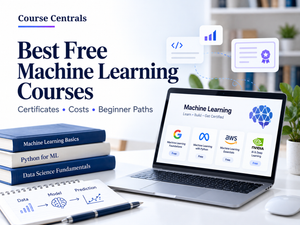
The best free machine learning course depends on whether you need a beginner-friendly first model, a completion certificate, or a deeper portfolio project. For most learners, start with Kaggle’s Intro to Machine Learning, which is free and lists a completion certificate. For conceptual foundations, Microsoft’s introductory module and Google’s Machine Learning Crash Course are strong alternatives. For a more demanding project-based route, Harvard’s CS50 AI and fast.ai are better suited to learners who already know Python.
This guide is the next step in the Course Centrals free-learning pathway. If you are new to coding, first review our free programming courses hub and free Python courses guide. If you already work with tables and datasets, our free SQL courses guide is a useful companion.
Quick comparison: free machine learning courses and certificate options
| Course and provider | Best for | Level and approximate duration | Learning access | Certificate or credential |
|---|---|---|---|---|
| Kaggle: Intro to Machine Learning | First hands-on models | Beginner with basic Python; about 3 hours | Free | Free Kaggle Learn completion certificate |
| Kaggle: Intermediate Machine Learning | Better model validation and data preparation | After introductory ML and pandas; about 4 hours | Free | Free Kaggle Learn completion certificate |
| Google: Machine Learning Crash Course | Core concepts plus interactive exercises | Beginner to intermediate; self-paced | Free | No verified certificate promise on the official course page |
| Microsoft Learn: Introduction to Machine Learning Concepts | Foundations without extensive coding | Beginner; about 1 hour 33 minutes | Free learning module | Microsoft Learn profile achievement/assessment, not an industry certification |
| Harvard CS50: Introduction to AI with Python | Rigorous Python projects | Intermediate; seven weeks of materials | Free OpenCourseWare | Free CS50 certificate after required graded work; optional paid edX verified certificate |
| fast.ai: Practical Deep Learning for Coders | Building and deploying deep-learning models | Intermediate; nine lessons of about 90 minutes each | Free | Do not assume a formal completion certificate |
| Kaggle: Intro to Deep Learning | First neural network after basic ML | Beginner-to-intermediate; about 4 hours | Free | Free Kaggle Learn completion certificate |
Verified against official provider pages on 8 October 2026. Course access, curricula, duration and credential terms can change. The labels above distinguish free course completion from paid verified credentials and professional/industry certifications.
1. Kaggle Intro to Machine Learning: best first practical course
Kaggle’s Intro to Machine Learning teaches how models work, data exploration, model validation, underfitting and overfitting, and random forests. The official course page estimates three hours and says there is no cost, with a completion certificate available after the required work.
Choose it if: you can write basic Python and want to train your first model quickly. Do not choose it as your only qualification: it is a short learning certificate, not an industry-recognized professional certification or a job guarantee.
2. Kaggle Intermediate Machine Learning: best next step after a first model
Intermediate Machine Learning focuses on missing values, categorical data, pipelines, cross-validation, XGBoost and data leakage. Kaggle lists approximately four hours and a free completion certificate.
Choose it if: you already understand train/test splits and want to improve how you prepare and evaluate tabular models. The practical lessons are particularly useful before attempting portfolio datasets.
3. Google Machine Learning Crash Course: best free conceptual foundation
Google’s Machine Learning Crash Course includes videos, visualizations, quizzes and browser-based exercises. Its topics cover regression, classification, data preparation, neural networks, embeddings and responsible machine learning. Google’s prerequisites guidance recommends comfort with Python and basic mathematics, although learners can use introductory prework to prepare.
Choose it if: you want to understand why models work and what can go wrong. It is free educational training; do not confuse it with a Google Cloud professional certification or assume that completing it awards a verified credential.
4. Microsoft Learn: best for a quick introduction without a paid course
Introduction to Machine Learning Concepts is a beginner-level Microsoft Learn module, currently estimated at one hour and 33 minutes. It covers regression, classification, clustering, deep learning, training and evaluation. The official page asks for basic mathematical knowledge.
Choose it if: you want a structured foundation before committing to a longer Python project. Microsoft Learn assessments and profile achievements are not the same as passing a separately administered Microsoft industry certification exam.
5. Harvard CS50 AI with Python: best for learners ready for substantial projects
CS50’s Introduction to Artificial Intelligence with Python offers seven weeks of free OpenCourseWare covering search, knowledge, uncertainty, optimization, learning, neural networks and language. Harvard recommends CS50x or about one year of Python experience. The official certificate policy states that students who meet the required project scores can earn a free CS50 certificate. A separate verified edX credential is paid.
Choose it if: you can already program and want a portfolio of substantial assignments. Before enrolling, check the current course FAQ for submission deadlines and certificate rules. Free CS50 completion certificates are not accredited academic degrees.
6. fast.ai Practical Deep Learning for Coders: best for practical deep learning
Practical Deep Learning for Coders is free and teaches practical work in computer vision, natural language processing, tabular modeling and model deployment. The course lists nine lessons of about 90 minutes each and assumes some coding experience.
Choose it if: your goal is to build and deploy models, not merely earn a course badge. Its published teaching materials are valuable even without a formal certificate.
7. Kaggle Intro to Deep Learning: best short bridge to neural networks
Kaggle Intro to Deep Learning covers neural networks, gradient descent, overfitting, dropout and binary classification using TensorFlow and Keras. Kaggle lists an estimated four hours, free access and a free completion certificate.
Choose it if: you have completed basic machine learning and want a manageable first neural-network project.
Which free machine learning course should you take first?
| Your situation | Start with | Then |
|---|---|---|
| New to Python | Free Python courses | Kaggle Intro to ML |
| Know Python, no ML experience | Kaggle Intro to ML | Google ML Crash Course |
| Business/analyst background | Microsoft Learn fundamentals | Kaggle Intro and Intermediate |
| Already built basic models | Kaggle Intermediate | fast.ai or CS50 AI |
| Want a free course certificate | Kaggle Intro or Intermediate | Portfolio project and documented results |
Free course vs free certificate vs professional certification
Free learning: the educational materials are accessible without paying. Free completion certificate: the provider issues evidence that you finished its course or required exercises. Paid verified certificate: a provider or platform charges for identity-verified documentation. Professional or industry certification: typically an assessment-based credential that is distinct from completing a short course. These terms are not interchangeable.
For example, Kaggle Learn’s completion certificates are free, while Harvard CS50 offers a free course certificate and a separate optional paid edX verified credential. A Microsoft Learn module achievement is not equivalent to an exam-based Microsoft certification.
A practical four-week beginner machine learning plan
- Week 1: refresh Python, basic statistics and data handling. Work through one dataset and identify its features and target.
- Week 2: finish Kaggle Intro to ML. Build and validate a simple decision-tree or random-forest model.
- Week 3: take Google ML Crash Course sections on evaluation and data preparation. Document a baseline model, validation metric and common failure modes.
- Week 4: complete Kaggle Intermediate topics on cross-validation and data leakage. Publish a small portfolio write-up that explains your question, dataset, method, limitations and results.
How to turn a free course into something useful for your CV
Employers can evaluate a clear project more easily than a list of course titles alone. Keep a repository or portfolio page that shows the dataset, problem statement, model, validation method, error analysis and what you would improve. Explain honestly what you built yourself and where you used AI tools.
After this machine learning foundation, you can explore our NVIDIA data science and machine learning courses guide to compare more specialized learning paths.
Frequently asked questions
Can I learn machine learning for free and get a certificate?
Yes. Kaggle Learn currently offers free courses including Intro to Machine Learning and Intermediate Machine Learning with completion certificates. Harvard CS50 AI also offers a free CS50 certificate if you meet its project requirements. These are not the same as accredited degrees or paid professional certifications.
Do I need Python before machine learning?
Not for every introductory concept module. However, Python is strongly recommended for practical model-building courses, especially Kaggle, Google exercises, Harvard CS50 AI and fast.ai.
Is Google Machine Learning Crash Course a Google certification?
No. It is a free Google educational course. Do not treat it as a Google Cloud professional certification unless Google explicitly identifies a separate assessed credential.
Which free machine learning course is best for complete beginners?
If you know basic Python, Kaggle Intro to Machine Learning is a strong first practical choice. If you do not yet code, begin with Python fundamentals and Microsoft’s conceptual introduction.
Can a free machine learning course get me a job?
A course can help you develop foundational skills, but it cannot guarantee employment. Practical projects, statistics, programming ability and the ability to explain model decisions matter for technical roles.
Course Centrals recommendation
Start small: choose one foundational course, complete its exercises, then build a portfolio project before buying a subscription. If you need more structure later, compare a longer professional certificate or assessed certification based on your actual career goal, not just the badge.