
For beginners choosing a first data-analysis skill, start with spreadsheets for cleaning and summaries, SQL for querying structured datasets, and Python when your tasks require repeatable automation or deeper analysis. You do not need to master all three before building a useful portfolio.
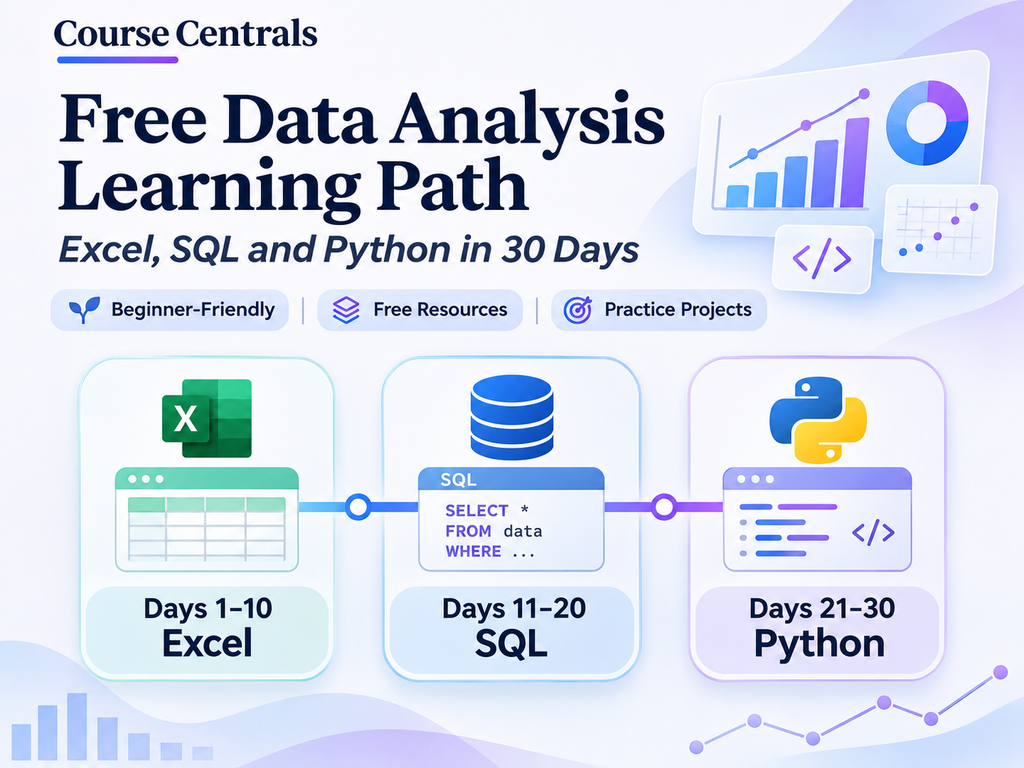
Excel, SQL and Python: the practical differences
| Skill | Best first use | Practice project | Next step |
|---|---|---|---|
| Excel | Small tables, formulas, charts and quick reports | Monthly sales tracker | PivotTables, XLOOKUP |
| SQL | Filtering, joining and summarising relational data | Customer orders analysis | JOIN, GROUP BY, window functions |
| Python | Automating repeatable workflows and working with data libraries | Clean a CSV and generate a summary | pandas and plotting |
A free 30-day learning path
Week 1: Understand your dataset in Excel
Import a CSV, clean inconsistent entries, calculate totals and create a chart. For a practical comparison, read Excel vs SQL vs Python and practise VLOOKUP exact matches.
Week 2: Learn SQL queries
Use SELECT, WHERE, GROUP BY and JOIN to answer business questions. Compare options in our free SQL courses guide and use SQL practice websites to test your skills.
Week 3: Learn Python and pandas
Read a CSV, inspect missing values, group records and export results. The official pandas getting started documentation explains core workflows. Also see our Kaggle Pandas course review for a guided learning option.
Week 4: Build one portfolio case study
Choose a public, non-sensitive dataset. Write three business questions, show your cleaning steps, explain the calculations, and present one chart and three recommendations. Publish a README explaining assumptions and limitations. Never upload personal or confidential data.
Which tool should you learn first?
Office or operations role: Excel first, then SQL. Analytics role: SQL and spreadsheets, then Python. Automation-heavy role: Python earlier, with enough SQL to retrieve data. Your starting point should reflect the work you want to do, not a universal ranking.
How to choose a free course responsibly
Check whether lessons are free to access, whether graded assessments are included, whether a certificate is free or paid, and whether the provider changes access terms. Verify those details on the official provider page before enrolling. Free learning access does not always mean a free certificate.
Common mistakes
- Learning syntax without solving a real problem.
- Buying a certificate before completing a free sample lesson.
- Using a large or sensitive dataset before learning basic cleaning and privacy.
- Claiming causation from simple correlations in a dashboard.
Frequently asked questions
Can I become a data analyst without Python?
Some entry-level reporting roles rely mainly on spreadsheets, SQL and dashboards. Python can expand your options, but the required tools vary by employer.
Do I need paid certificates?
No single certificate guarantees a role. A clearly explained portfolio project is useful evidence of practical ability; check job requirements for your target market.
What should my first portfolio project contain?
A problem statement, data source, cleaning log, reproducible calculations, chart, limitations and concise recommendations.
Editorial review required before publishing: check course pricing and certificate availability against each provider’s current official pages, add a downloadable sample dataset, and verify internal link destinations.