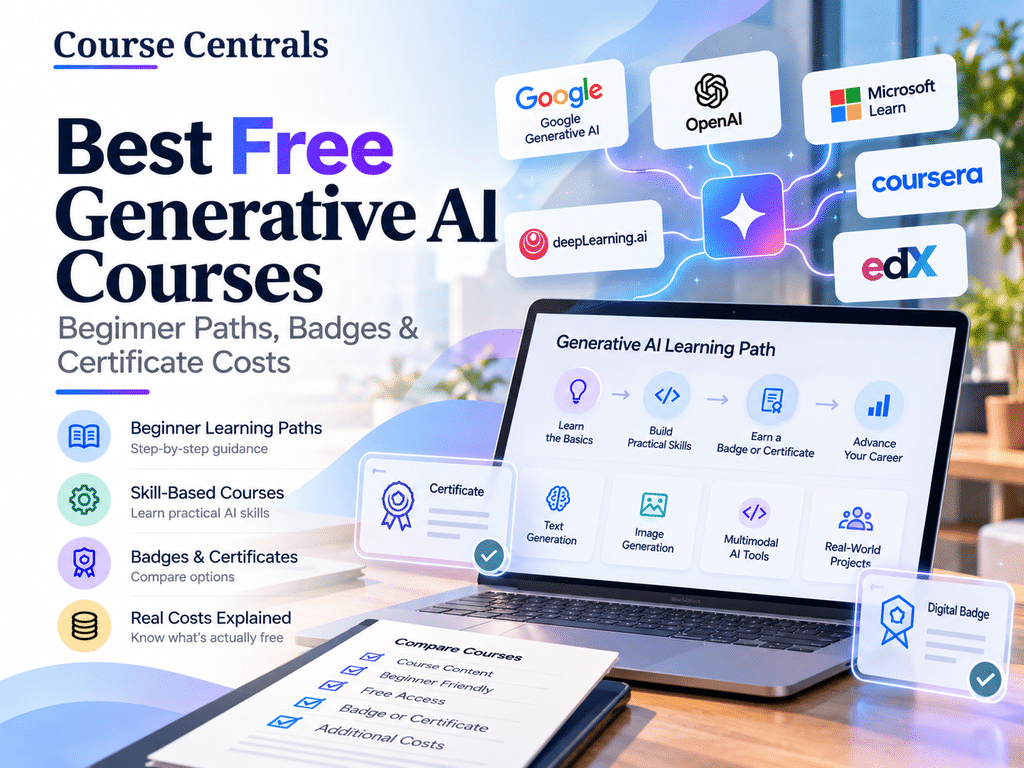
The best free generative AI course depends on what you want to do. For a short introduction, start with Google Skills’ Introduction to Generative AI or Microsoft Learn’s Explore Generative AI. For an applied business perspective, consider DeepLearning.AI’s Generative AI for Everyone. For a structured route with a potential free digital credential, investigate IBM SkillsBuild’s Getting Started with Generative AI. These options are not equivalent: free lessons, completion badges, paid certificates and professional certifications have different requirements.
This guide is for beginners, students, marketers and working professionals learning to use generative AI responsibly. Developers who already know Python should also see our free machine learning courses guide and, when published, our separate technical LLM course comparison. If you are starting from zero, our Programming and Free Courses hub and free Python courses guide provide a foundation.
Best free generative AI courses compared
| Course/provider | Best for | Level and time | Learning cost | Credential reality |
|---|---|---|---|---|
| Google Skills: Introduction to Generative AI | Quick explanation of generative AI, use cases and Google tools | Introductory, 45 minutes | Previously listed as no-cost; confirm current enrollment terms | Course page advertises a badge; distinguish a completion badge from a professional certification |
| Microsoft Learn: Explore Generative AI | Absolute beginners, content creation and productivity | Beginner, 37 minutes | Free learning module | Microsoft Learn XP and module assessment, not an exam-based certification |
| Microsoft Learn: Introduction to Generative AI and Agents | Understand LLMs, prompts and AI agents | Beginner, 37 minutes; basic AI/ML familiarity recommended | Free learning module | Assessment pass designation on Learn profile, not an industry certification |
| IBM SkillsBuild: Getting Started with Generative AI | Responsible AI and foundational AI concepts | Foundational; verify track duration in catalog | IBM SkillsBuild advertises free learning | Catalog advertises an earnable digital credential, subject to completing required activities |
| DeepLearning.AI: Generative AI for Everyone | Business use cases and AI strategy | Beginner, about 5 hours | Learning videos available on provider platform; confirm current free-access terms | Provider explicitly labels certificate and graded assignments as PRO features |
Provider pages checked on 11 October 2026. Access, promotional pricing and badge conditions can change. The table distinguishes free educational content from a free credential.
1. Google Skills: Introduction to Generative AI
Best for a fast orientation. Google’s introductory course explains what generative AI is, how it differs from traditional machine learning, common model types and applications. The current official page lists 45 minutes and promotes a course badge. It is a useful starting point before moving to prompting or building applications.
Free versus credential: Google’s older course listing explicitly described the micro-course as no-cost, while the current Google Skills page emphasizes its badge and does not display a clear price in the public text. Check the live enrollment screen before assuming every activity is free. A course badge is not the same as a Google Cloud professional certification exam.
Try this: write down three examples of generative AI and three predictive ML examples. Explain how the tasks differ without using marketing jargon.
2. Microsoft Learn: Explore Generative AI
Best for learners who want a no-cost, bite-sized foundation. Microsoft’s 37-minute, nine-unit module explains the differences among natural-language processing, natural-language generation and large language models, then looks at generative AI in productivity and content creation.
Access: Microsoft Learn training modules are available to study online. The module includes an assessment and Microsoft Learn profile progress. It does not claim to award an exam-based Microsoft certification. Some optional exercises may direct you to products or services with separate terms.
Try this: create a short fact-checked article outline with an AI assistant, then annotate which claims required independent verification.
3. Microsoft Learn: Introduction to Generative AI and Agents
Best bridge between everyday AI use and technical AI concepts. This separate 37-minute module introduces LLMs, prompts, agents and agentic AI solutions. It includes a practical exercise and an assessment. Microsoft lists basic familiarity with AI concepts and machine learning as prerequisites, so absolute beginners may prefer Explore Generative AI first.
Certificate: passing the assessment can earn a designation on your Microsoft Learn profile. It should not be advertised as a standalone Microsoft certification.
Try this: describe the difference between asking a model to summarize text and designing an agent that retrieves information and takes an action.
4. IBM SkillsBuild: Getting Started with Generative AI
Best for learners who specifically value a digital credential. IBM SkillsBuild’s catalog currently features Getting Started with Generative AI (Earn a digital credential!). Its description covers generative AI foundations, ethics and risks, large language models and practical scenarios, including responsible model use.
IBM SkillsBuild describes its education as free, but learners should open the specific catalog item, check account eligibility and finish all required activities before expecting a badge. A shareable IBM digital credential is different from a paid, proctored professional certification.
Try this: produce a one-page AI risk checklist for a hypothetical university admissions chatbot, covering hallucinations, personal information, fairness and human review.
5. DeepLearning.AI: Generative AI for Everyone
Best for practical business judgment. Andrew Ng’s course is listed as a beginner program of approximately five hours. It explores what generative AI can and cannot do, workplace use cases, project selection and responsible implementation. It does not require coding experience.
Important cost distinction: the provider’s current course page explicitly marks the completion certificate and graded assignments as PRO features. Do not enroll solely because another website claims the certificate is free. Confirm what can be watched without paying and whether the exercises you need require membership.
Try this: select a repetitive work task, estimate the time saved by an AI-assisted workflow, identify where human approval remains necessary, and design a simple quality-control checklist.
Which free generative AI course should you choose?
- Absolute beginner with 45 minutes: Google Skills Introduction to Generative AI, then Microsoft Learn Explore Generative AI.
- Student wanting a verifiable learning record: investigate the IBM SkillsBuild credential pathway, checking the current badge requirements first.
- Marketer or project manager: take DeepLearning.AI’s business-oriented course and apply it to a real task; decide whether the PRO certificate is worth paying for.
- Developer curious about agents: begin with Microsoft Learn’s agents module, then advance to our machine learning course comparison and deeper LLM material.
- Someone looking for a job-ready AI certification: these short learning modules alone are unlikely to be sufficient. Compare structured Google Professional Certificates and project-based learning paths.
What does ‘free’ actually mean?
| Label | What it means | What to check |
|---|---|---|
| Free lessons | Videos and reading can be accessed without a course fee | Whether labs, quizzes or advanced modules are locked |
| Free completion badge | A shareable badge is issued after meeting stated requirements without payment | Identity, assessment and account requirements |
| Paid certificate | The certificate requires subscription or a fee, even if lessons can be viewed free | Billing and cancellation conditions |
| Professional certification | A separate credential, often requiring an exam or substantial assessed work | Exam fee, prerequisites and renewal |
| Free course with paid tools | Training is free, but hosted APIs, cloud credits or computing can cost money | Usage limits and cost controls before launching a project |
A four-week beginner roadmap
- Week 1, concepts: complete a short Google or Microsoft introduction. Explain generative versus predictive AI, hallucinations and responsible use.
- Week 2, prompts: practice giving context, constraints, examples and evaluation criteria. Compare outputs across several prompts and record errors.
- Week 3, applied workflow: choose a real task, such as summarizing verified course information or drafting a scholarship research checklist. Keep human review for factual claims.
- Week 4, evidence of skill: publish a portfolio case study describing the problem, your prompts, evaluation criteria, limitations and measurable result. Claim a credential only when its official requirements have been met.
This is a Course Centrals suggested plan, not an official provider timetable. Learners who want to code should also strengthen Python fundamentals and use our data analysis guide to practice working with real datasets.
Generative AI courses versus LLM courses
Generative AI is the broader field of systems that create text, images, audio, video and other content. Large language models are one important part of that field. A beginner generative AI course usually teaches concepts, responsible use and everyday applications. A technical LLM course goes deeper into transformers, tokenization, retrieval, fine-tuning, evaluation and model deployment. Choose the path that matches your outcome rather than treating the terms as interchangeable.
Frequently asked questions
Can I learn generative AI for free without coding?
Yes. Google’s introductory course, Microsoft’s beginner modules and DeepLearning.AI’s business-focused program are designed for learners who do not need to write code to understand the fundamentals. Verify the provider’s current free-access terms before enrolling.
Which free generative AI course includes a certificate?
IBM SkillsBuild advertises a generative AI learning route with an earnable digital credential. Google’s introductory course advertises a badge. Requirements and availability must be confirmed at enrollment. Microsoft Learn module assessments are not the same as professional certifications, and DeepLearning.AI labels its certificate as a PRO feature.
Is a free generative AI course enough to get a job?
Not on its own. A short course can demonstrate initiative and build foundational understanding, but employers generally need evidence that you can apply skills. Pair your learning with a relevant portfolio project, domain knowledge and, where appropriate, deeper technical training.
Should I learn Python before generative AI?
Not for basic use, prompting or business strategy. Python becomes more useful if you want to build applications, evaluate models, connect APIs or work with open-source models.
Are free courses the same as Google, Microsoft or IBM certifications?
No. A free module, course badge, shareable digital credential and exam-based certification are different products. Always check the provider’s precise wording and assessment requirements.
Next steps
Start with one short course and one practical deliverable rather than collecting several introductory certificates. For a technical path, move through Python, data analysis and machine learning before advanced LLM application development. For a professional path, compare structured certificate programs and confirm their real cost before paying.
Verification note: provider descriptions and public course listings reviewed on 11 October 2026. Availability, regional access, badges and subscription terms may change. Course Centrals recommends verifying each official enrollment page before paying or making a credential claim.