
A strong Statement of Purpose (SOP) explains what you want to study, how your academic and research experience prepared you, why a specific graduate program fits your goals, and what you plan to do next. For master’s and PhD applications, the best SOPs are specific, evidence-based, tailored to the program, and written in your own voice. Always follow the exact prompt and word limit set by the university or department.
If you are still choosing funding opportunities, start with our fully funded scholarships for international students guide and use the Course Centrals Scholarship Finder to explore opportunities before tailoring your application materials.
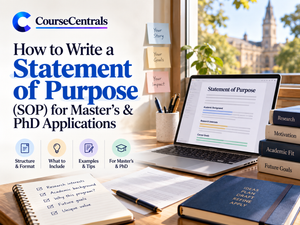
What is a Statement of Purpose?
A Statement of Purpose is an application essay used by many graduate programs to understand your academic preparation, research or professional interests, reasons for pursuing graduate study, program fit, and future goals. It is not simply a biography or a longer version of your CV.
Official university guidance shows why there is no universal SOP formula. Stanford asks applicants to address their reasons for applying, preparation, research interests and career plans, while Yale asks applicants to explain research interests, preparation and how Yale faculty, research and resources would contribute to their goals. Cornell similarly emphasizes academic background, preparation, informed program fit and future potential.
How long should an SOP be?
Use the university’s instructions first. There is no single correct length. Stanford recommends a maximum of 1,000 words for its general graduate SOP, Yale’s current general prompt specifies 500–1,000 words for many applicants, and Cornell notes that one to two pages is typical unless a program says otherwise. Other institutions and individual departments may use different limits.
| Rule | What to do |
|---|---|
| Your program gives a word or character limit | Follow it exactly. |
| Your department gives a specific prompt | Answer every part of that prompt. |
| No length is stated | Write concisely and check the graduate school and department guidance before deciding on length. |
| Applying to several universities | Tailor the SOP for each program rather than sending the same version everywhere. |
What should a strong SOP include?
Across official graduate admissions guidance, several themes recur: academic interests, preparation, relevant experience, future direction and evidence that you understand the program you are applying to.
1. Your academic direction
Open with the field, problem or research area you want to pursue. Avoid a generic life story. Give the reader a clear sense of your academic direction and why graduate study is the logical next step.
2. Your preparation and relevant experience
Show rather than merely claim that you are prepared. Relevant evidence can include coursework, research projects, a thesis, laboratory or field experience, internships, professional work, publications, presentations or substantial independent projects. Explain your role, what you learned and how the experience shaped your next academic step.
3. Your research or study interests
Be specific enough to demonstrate direction without pretending that your interests can never change. For research degrees, explain the questions or areas you want to investigate and how your previous experience led you there.
4. Why this program?
This is where a generic SOP often fails. Connect your interests to specific aspects of the program such as faculty expertise, research groups, laboratories, curriculum or other academic resources. Cornell explicitly advises research-degree applicants to identify faculty whose research aligns with their interests, while UCLA encourages applicants to identify research interests and potential faculty mentors for research master’s and doctoral programs.
5. Your future goals
Explain what the degree enables you to do next. The goal does not need to predict your entire career, but it should make the relationship between your past preparation, graduate study and future direction coherent.
A practical SOP structure
| Section | Main question to answer | Evidence to use |
|---|---|---|
| Opening | What do you want to study and why now? | Academic/research motivation |
| Preparation | What has prepared you for graduate study? | Courses, research, thesis, work, projects |
| Research or study direction | What questions or areas interest you? | Specific interests and intellectual development |
| Program fit | Why this program rather than any program? | Faculty, labs, curriculum, research resources |
| Future direction | What will you do with the degree? | Research, professional or academic goals |
| Conclusion | Why are you ready for this next step? | Concise synthesis, not repetition |
Master’s SOP vs PhD SOP: what changes?
The underlying principles overlap, but the emphasis often differs.
| Master’s SOP | PhD SOP |
|---|---|
| May place greater emphasis on advanced study, specialization and professional direction. | Usually needs a stronger account of research preparation, research questions and potential scholarly direction. |
| Relevant professional projects can be particularly important for professionally oriented programs. | Prior research, thesis work, methods and evidence of research readiness often deserve more space. |
| Program fit may focus on curriculum, specialization and faculty. | Research fit with faculty, labs or research groups can be especially important. |
| Career goals can help explain why the degree is needed. | Academic/research trajectory and ability to sustain doctoral research should be clear. |
Do not apply this distinction mechanically. The actual department prompt is more important than any general template. Some research master’s programs may expect an SOP that looks much closer to a PhD statement.
SOP vs personal statement vs motivation letter
These terms are sometimes used inconsistently. When an institution requests both an SOP and a personal statement, the SOP is commonly more academically focused, while the personal statement may ask about personal experiences, background or contribution to the community. Harvard, for example, separately describes its Statement of Purpose and Personal Statement. UC Davis also requires separate responses. Never assume the documents are interchangeable: read the institution’s prompt.
Statement of Purpose template
Use this as a planning framework, not text to copy.
- Opening: State the academic/research direction you want to pursue and the reason graduate study is your next step.
- Preparation: Select two or three experiences that best demonstrate your readiness. Explain outcomes and learning rather than listing everything on your CV.
- Current interests: Define the problems, themes or specialization you want to explore.
- Program fit: Connect those interests to specific faculty, research, curriculum or resources at the target university.
- Future goals: Explain how the degree fits your next academic or professional stage.
- Conclusion: Bring preparation, fit and direction together in a short, confident closing.
Weak vs stronger SOP writing
| Weak approach | Stronger approach |
|---|---|
| “I have always been passionate about science.” | Identify the specific project, question or experience that developed your present academic interest. |
| “Your university is world-renowned.” | Explain which program resources or research strengths match your goals and why. |
| “I have excellent research skills.” | Describe a research task, your contribution, method or result that demonstrates those skills. |
| List every achievement. | Select evidence that supports the argument that you are prepared for this particular program. |
| Use the same SOP for every application. | Keep your core story but rewrite the program-fit section and respond to each institution’s exact prompt. |
Common SOP mistakes to avoid
- Ignoring the prompt: a polished essay can still fail if it does not answer what the department asks.
- Repeating your CV: use experiences to explain development, preparation and direction.
- Writing a generic program-fit paragraph: name only faculty or resources that genuinely connect to your interests.
- Making unsupported claims: demonstrate qualities through evidence.
- Overusing autobiography: personal context can matter, but an academic SOP should stay focused on preparation and purpose unless the prompt asks otherwise.
- Using inaccurate faculty information: verify that a professor is currently affiliated with the program and that their work actually matches your interests.
- Exceeding the stated limit: application instructions take priority over general advice.
- Submitting without proofreading: clarity and accuracy matter in a document that also demonstrates communication ability.
Can you use AI or ChatGPT to write an SOP?
Check each institution’s policy before using generative AI. Policies can differ. AI may be useful for brainstorming questions, identifying unclear sentences or checking organization where permitted, but the academic experiences, motivations, research interests and program fit must be accurate and genuinely yours. Do not invent research, achievements, faculty connections or experiences. UCLA explicitly warns that application essays relying heavily or entirely on AI may be treated as academic dishonesty. Your safest approach is to use your own experiences and voice and follow the target institution’s rules.
SOP checklist before you submit
- Have I answered the exact university and department prompt?
- Am I within the required word or character limit?
- Is my intended academic or research direction clear?
- Have I shown evidence of preparation rather than only making claims?
- Have I explained what I learned from my most relevant experiences?
- Is the program-fit section specific and factually accurate?
- For a research degree, have I explained relevant research interests and fit?
- Are my future goals connected logically to the degree?
- Have I removed generic praise that could describe any university?
- Have I checked names, program titles and faculty details?
- Have I proofread the final version and, where possible, asked a trusted academic or mentor for feedback?
Frequently asked questions
What is the best way to start a Statement of Purpose?
Start with your academic or research direction and the motivation for pursuing graduate study. You do not need a dramatic childhood story. The opening should quickly establish what you want to study and give the reader a reason to continue.
Should I mention professors in my SOP?
For research-focused programs, mentioning potential faculty can be useful when their current research genuinely aligns with your interests and the program encourages it. Verify the faculty member and explain the intellectual connection rather than simply listing names.
Should an SOP include weaknesses or challenges?
Only when relevant to the prompt or necessary to explain your academic path. Keep the emphasis on context, what you learned and evidence of readiness rather than turning the SOP into a list of problems.
Is an SOP the same as a scholarship essay?
Not necessarily. A graduate admissions SOP usually focuses on academic preparation, interests, program fit and goals. A scholarship essay may instead emphasize eligibility, leadership, impact, financial context, career plans or the scholarship’s mission. If a scholarship asks for an SOP, follow that scholarship’s specific prompt.
Can I use one SOP for multiple universities?
You can reuse your factual foundation, such as your academic background and core research interests, but each application should be tailored to its prompt and program. Program fit should never be copied unchanged across universities.
Official sources used for this guide
- Cornell Graduate School: Academic Statement of Purpose
- Stanford Graduate Admissions: Statements
- Yale Graduate School: Application FAQs
- UCLA Graduate Admissions: Application Requirements
- Harvard Griffin GSAS: Statement of Purpose and Personal Statement
- Duke Graduate School: Statement of Purpose