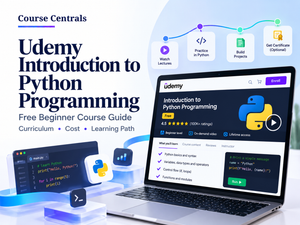
Udemy Introduction to Python Programming is a beginner-focused course for learners who want to understand Python fundamentals without committing to an advanced programming program. This guide explores the course curriculum, prerequisites, learning experience, access conditions and certificate availability to help you decide whether it’s a suitable starting poin
Course at a glance
| Course | Introduction To Python Programming |
| Instructors | Avinash Jain and The Codex |
| Platform / language | Udemy / English |
| Structure | 3 sections, 22 lectures, approximately 1 hour 10 minutes |
| Starting level | No previous programming experience required |
| Cost | Listed as a free introductory course; check enrollment terms |
| Certificate | No completion certificate for a new free-course enrollment |
Source: official course listing. Its displayed content-update date is July 2024, so inspect the preview and tool instructions before committing your time.
What Is Udemy Introduction to Python Programming?
The listing introduces variables, arithmetic, strings, control flow and basic object-oriented programming, including inheritance. It also includes a coding exercise. These are introductory topics; brief exposure to a concept is different from being able to apply it independently.
What Will You Learn in This Python Course?
Our editorial expectation is that a short introduction can help you understand what Python code looks like and whether you enjoy working with it. Do not interpret the lecture duration as a promise of proficiency. For each concept, write a small example yourself, change the inputs and explain the result before moving on.
How long should you allow?
The listed video duration excludes time spent pausing, practicing and correcting mistakes. Our suggested first goal is to complete a small working script after a few focused study sessions, rather than finish every video as quickly as possible. This is a learning recommendation, not an instructor completion estimate.
If the installation or editor instructions differ from your current computer, use current Python documentation to resolve the setup. You should be comfortable running your own examples before deciding whether to continue into a larger course.
Does the free course include a certificate?
No. Udemy’s official certificate FAQ says free courses do not provide completion certificates. There is a historical exception for free enrollments before 17 March 2020; it should not be presented as a benefit for new learners.
Udemy also states that its completion certificates are not formal accreditation. Paying for a different course does not turn that course into a university qualification or an independent professional certification. Check the credential you actually need before choosing a course on that basis.
Who should take it?
- People who want a brief first exposure before investing in a substantial Python path.
- Learners who prefer video explanations and are willing to practice separately.
- Beginners who want to check whether programming interests them.
Who should choose a longer course?
Our recommendation is to choose a more substantial path if you need regular assessment, a larger sequence of projects or a supported route to a certificate. Learners pursuing data analysis should also look for SQL, working with datasets and relevant analysis tools. A short general introduction alone cannot cover that broader goal.
A practical way to use the introduction
- Watch a short lesson, then close it and recreate a simple example.
- Change the example to solve a small everyday problem.
- Add invalid input and check that your script handles it sensibly.
- Keep notes explaining what went wrong and how you fixed it.
- Use the result to decide whether to progress to a more demanding course.
For example, build a small unit converter or a basic expense totaler. These are our suggested exercises, not official assignments. Start with a small scope and make it reliable before adding features.
Udemy introduction versus CS50 Python and freeCodeCamp
| Udemy introduction | Short video route to sample the language |
| CS50 Python | Structured foundations with assessed work and a final project |
| freeCodeCamp Python | Interactive practice with a separate certification pathway |
This is our editorial comparison of learning purposes. Compare the actual practice tasks, not only the provider name or certificate label. The best first course is the one you will use actively and can follow at your current level.
Frequently asked questions
Is the course still free?
The course has been listed as free. Confirm the current price on the official enrollment page; pricing and availability can change.
Can I learn enough Python in an hour?
You can gain an initial overview. Our assessment is that independent programming requires additional practice, debugging and projects, so video duration should not be confused with time to competence.
Should I take it for the certificate?
No. New free-course enrollments do not include a completion certificate.
What should I do next?
Choose a longer Python path if you enjoyed the exercises. If your goal is working with data, add a SQL course and a small dataset project rather than immediately collecting more introductions.
Related Course Centrals guides
Sources and review notes
official course listing and Udemy certificate FAQ. Recommendations are editorial assessments of the published course information, not claims of personal course completion.