
Build practical database development skills using SQL, Java and JDBC with this beginner-friendly course developed by Amazon and delivered through Coursera.
Amazon · Coursera · Beginner · Self-paced
Course · Approx. 3 weeks · Online
Affiliate disclosure: Course Centrals may earn a commission if you enrol through our links, at no additional cost to you.
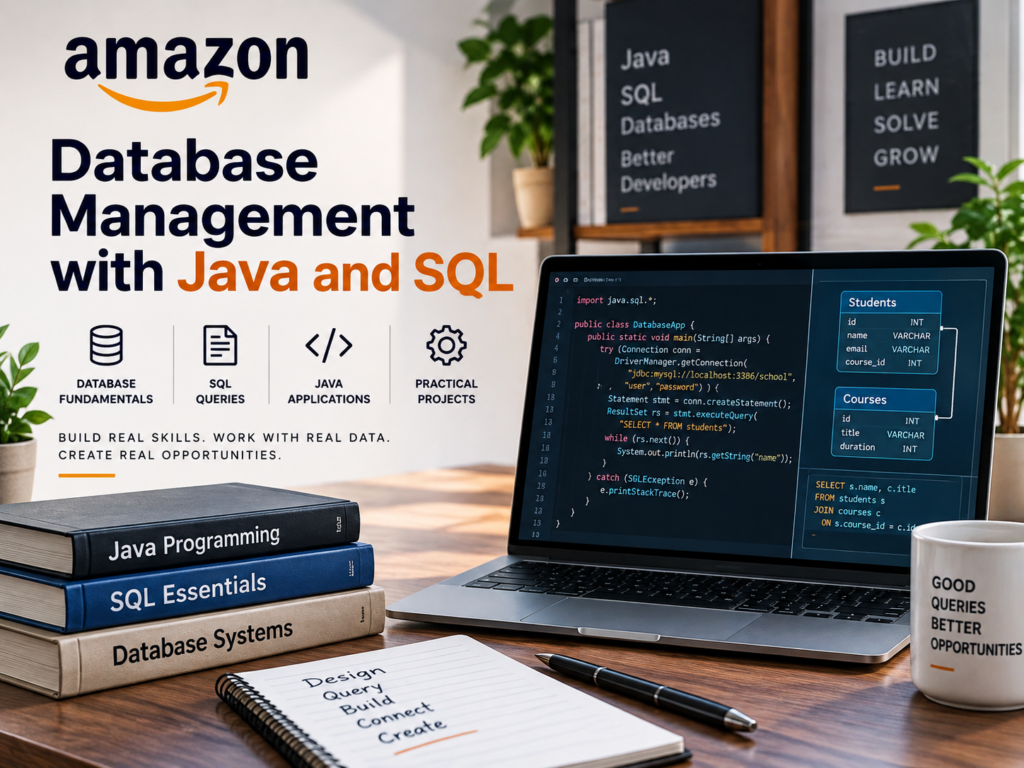
Database Management with Java and SQL is an Amazon-developed course designed to introduce learners to relational databases, SQL and database integration with Java applications. The course covers database structures and queries before progressing into JDBC, database connectivity and building interfaces that work with stored data. Learners finish by applying these concepts in a database-driven application project.
Why Consider This Course?
- Amazon-Developed Curriculum
- Learn through a software development course created by Amazon.
- SQL + Java Combination
- Develop database skills while learning how Java applications interact with relational databases.
- Hands-On Learning
- Work through practical activities, programming assignments and database exercises.
- Beginner Friendly
- Designed to develop foundational database knowledge without requiring advanced database experience.
- Part of a Larger Path
- The course is also Course 4 within Amazon’s Junior Software Developer Professional Certificate.
What You’ll Learn
By completing this course, learners will develop practical knowledge across six core areas:
- Relational Database Fundamentals – Understand tables, data types, keys and relationships within relational databases.
- SQL Queries – Retrieve, filter, sort, group and manipulate data using SQL.
- Database Joins – Combine information across related tables using common SQL join techniques.
- Java Database Connectivity (JDBC) – Connect Java applications to databases and execute database operations.
- Database Transactions – Work with DDL, DML and transaction concepts when managing data.
- Database Applications – Integrate databases with Java applications and build interfaces for displaying and working with data.
Who Is This Course For?
Best suited for:
Beginners learning software development, aspiring Java developers, and learners who want to understand how applications connect to and work with relational databases.
May not suit:
Experienced database developers or learners primarily looking for advanced database administration, cloud databases, data engineering or NoSQL training.
Skills Covered
SQL · Database Management · Relational Databases · Java · Java Programming · JDBC · Database Design · Database Development · Transaction Processing · Data Access
Course Structure
- 1. Introduction to Databases
- Database fundamentals, SQL queries, filtering, aggregation, joins and relational database concepts.
- 2. Databases and Java
- JDBC architecture, database connections, DDL/DML operations and transaction management.
- 3. Displaying Data
- JavaFX interfaces, database integration, data retrieval and displaying database information in applications.
- 4. Final Project and Assessment
- Bring the concepts together by developing a Library Management System using database design, SQL, Java and JavaFX.
Course Centrals View
Database Management with Java and SQL is a useful choice for learners who want to understand databases from a software developer’s perspective rather than study SQL in isolation. Its combination of relational databases, SQL, Java and JDBC helps connect database concepts to actual application development. However, learners pursuing dedicated database administration or data engineering careers will eventually need deeper database, cloud and infrastructure knowledge.
Things to Consider
- Java Context
- The course connects database concepts heavily with Java, making it particularly relevant to learners following a Java development path.
- Focused Scope
- It provides foundational database development skills rather than advanced database administration or data engineering training.
- Practice Matters
- Building additional database-driven applications beyond the course will help reinforce SQL, JDBC and database design skills.
Career Paths After This Course
- Junior Java Developer
- Build and maintain Java applications that interact with databases and other application services.
- Junior Software Developer
- Support application development while working with programming logic, databases and software components.
- Backend Developer
- Develop server-side application functionality and work with databases, APIs and application logic.
- Database Application Developer
- Build applications that store, retrieve and manipulate information using relational databases.
To strengthen your profile further, continue developing Java and SQL, learn Git and version control, build database-backed applications, and develop broader backend development skills.
Ready to Start
Build practical SQL, database management and Java database connectivity skills with Amazon’s Database Management with Java and SQL course.