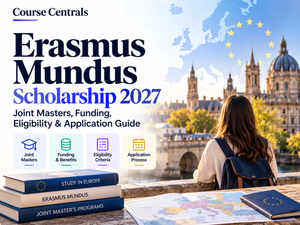
Quick answer: Erasmus Mundus Joint Masters are international master’s programs delivered by groups of universities, with competitive EU-funded scholarships available to top students worldwide. For scholarship holders, EU support is calculated at €1,400 per month for the duration of the master’s programs, up to 24 months. Most student applications are submitted directly to the individual master’s consortium between October and January for programs starting the following academic year.
If you are comparing major international awards for 2027, start with our Fully Funded Scholarships for International Students 2027 guide and use the Course Centrals Scholarship Finder to browse additional opportunities.
What is the Erasmus Mundus Joint Masters scholarship?
Erasmus Mundus Joint Masters, often shortened to EMJM, are highly integrated master’s programmes run by international consortia of higher education institutions. Students study in more than one country and may graduate with either a joint degree or multiple degrees, depending on the programme.
The programmes normally last one to two academic years and carry 60, 90 or 120 ECTS credits. Competitive scholarships are available to excellent students from around the world.
Erasmus Mundus scholarship at a glance
| Study level | Master’s |
| Who can apply | Students worldwide who meet the chosen programme’s admission rules |
| Programme duration | 1 to 2 academic years |
| Scholarship support | €1,400 per month, calculated for the programme duration, up to 24 months |
| What support contributes to | Travel, visa, installation and subsistence costs; scholarship holders are not charged tuition or mandatory participation costs under the programme rules |
| Typical application period | Usually October to January for courses starting the following academic year |
| How to apply | Directly to the individual Erasmus Mundus master’s consortium |
What does the Erasmus Mundus scholarship cover?
The EU scholarship contribution is calculated at €1,400 per month for the duration of the master’s programme. Erasmus+ rules describe the scholarship as a contribution toward costs including travel, visa, installation and subsistence. Scholarship holders are also not charged tuition fees or other mandatory participation costs by the selected project.
For a 24-month master’s, the monthly calculation can therefore reach €33,600 across the study period. The exact study duration and arrangements depend on the individual programme.
Who is eligible?
There is no single universal admissions checklist for every Erasmus Mundus Joint Master. Each consortium sets its own academic background, language, document and programme-specific requirements. In general, applicants should hold a bachelor’s degree or be in the final year of bachelor’s study and graduate before the master’s begins.
Because eligibility varies by programme, always treat the official page of the specific Joint Master as the final source of truth.
When do Erasmus Mundus 2027 applications open?
The European Commission says that, in most cases, students apply between October and January for courses starting the following academic year. In July 2026, Erasmus+ announced that newly selected Joint Masters would begin opening for student applications in autumn 2026.
There is no single Erasmus Mundus deadline. Each master’s consortium publishes its own scholarship and admissions dates. That makes early programme selection important.
How to apply for Erasmus Mundus in 2027
- Browse the Erasmus Mundus catalogue. Identify programs that match your academic background and career goals.
- Open the individual programme website. Check scholarship eligibility, required degree, language requirements and country rules.
- Check the exact scholarship deadline. Do not assume every programme closes in January.
- Prepare your documents. Common requirements can include transcripts, degree evidence, CV, motivation material, references and proof of language ability, but the consortium’s list controls.
- Apply directly to the consortium. Student applications are not submitted through one central Erasmus scholarship form.
- Track programme communication. Selection timelines and interview requirements vary.
Erasmus Mundus vs Chevening
Both can fund postgraduate study, but they work differently. Erasmus Mundus is tied to specific multinational Joint Masters and usually involves study in multiple countries. Chevening is a UK government scholarship for eligible master’s study in the United Kingdom and has its own leadership, work-experience and return-home requirements.
If you are based in the UAE, you can also compare the Rhodes Scholarship UAE guide, which follows a very different Oxford-focused selection model.
How to strengthen your application
Start with programme fit. A strong application should make it clear why your academic background connects to the specific Joint Master, why the programme’s international structure matters to your goals, and what you can contribute to the cohort. Generic scholarship statements are less useful than evidence tied directly to the programme.
Frequently asked questions
Is Erasmus Mundus fully funded?
Selected scholarship holders receive EU scholarship support calculated at €1,400 per month for the master’s duration, and programme rules state that scholarship holders cannot be charged tuition or mandatory participation costs. The scholarship contribution is intended to support travel, visa, installation and subsistence costs.
Can international students apply?
Yes. Erasmus Mundus Joint Masters are open to students worldwide, subject to the eligibility rules of the individual programme.
Is there one Erasmus Mundus 2027 deadline?
No. The European Commission says most applications are submitted between October and January, but each Joint Master publishes its own deadline.
Do I apply through Erasmus+ directly?
No. Students apply directly to the institution or consortium running the chosen Joint Master.