
A strong academic CV for graduate admissions is not simply a job resume with extra pages. It should help an admissions committee quickly understand your academic preparation, research experience, projects, publications, awards, teaching, technical skills and other evidence that you are ready for advanced study. Requirements vary by university and program, so always check the specific application instructions before submitting.
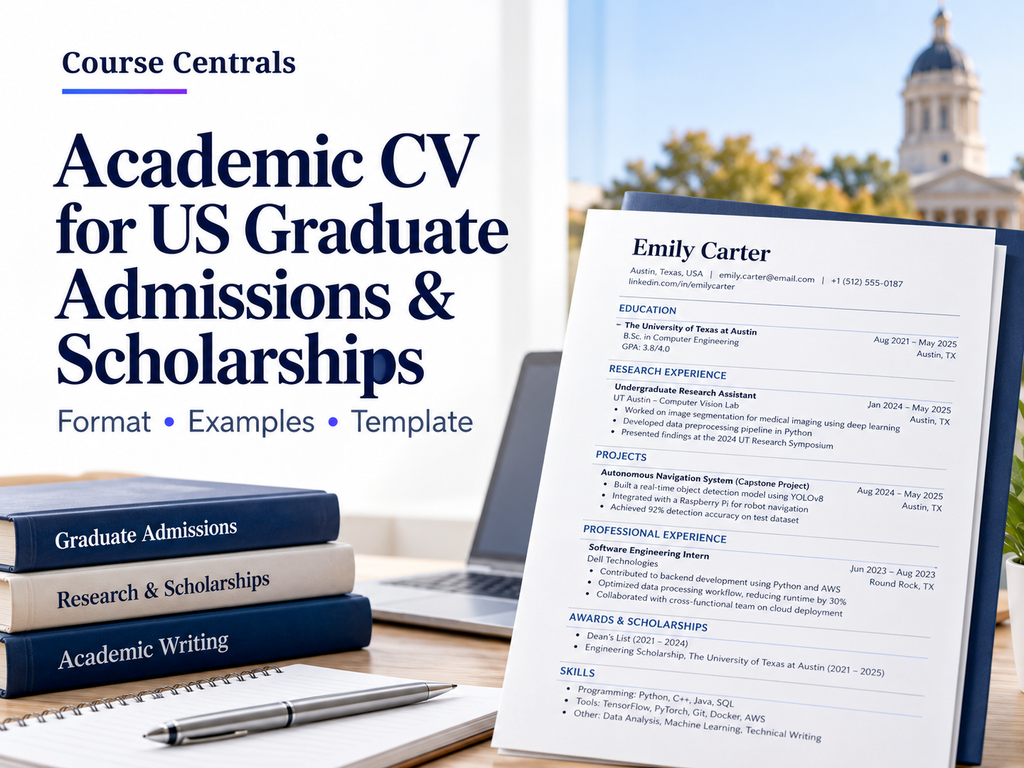
Academic CV for US Graduate Admissions & Scholarships: Format, Examples & Template
Universities may ask for either a CV or a resume. Princeton Graduate School, for example, allows applicants to upload a resume or curriculum vitae, while Cornell explains that a CV is generally more detailed and academic in focus. A resume is normally shorter and more selective.
| Document | Typical focus | Best suited for |
|---|---|---|
| Academic CV | Education, research, publications, presentations, teaching, awards, academic projects | Research-heavy Master’s, PhD, scholarships, fellowships, academic opportunities |
| Resume | Selected skills, employment, achievements and experience | Professional Master’s programs or applications that explicitly request a resume |
Do not assume a universal one-page or two-page rule for an academic CV. Cornell notes that CVs can range from two pages to several pages, depending on experience, while its graduate applicant handout says two pages is normal for many early-stage applicants. The right length is the shortest length that presents your relevant academic record clearly.
What to Include in a Academic CV for Graduate School
Your strongest sections should appear early. For most Master’s and PhD applicants, the following structure works well:
1. Name and Contact Details
Use your full name, professional email address, phone number, city/country and, where useful, a LinkedIn, portfolio, GitHub or academic profile link. Avoid unnecessary personal information unless the university specifically requests it.
2. Education
List degrees in reverse chronological order. Include institution, degree, field, dates and relevant academic distinctions. Add GPA or class rank only when it strengthens the application or the program asks for it.
3. Research Experience
For research-focused programs, this is one of the most important sections. Include the project or lab, supervisor, institution, dates, your role and what you actually contributed. Emphasize methods, analysis, outcomes and research skills rather than vague duties.
4. Academic Projects
If you have limited formal research experience, strong university projects can still demonstrate readiness. Include the question you worked on, the methods or tools used and the outcome.
5. Publications and Presentations
List peer-reviewed papers, preprints, conference papers, posters or presentations where relevant. Use a consistent citation style and clearly distinguish published work from manuscripts in preparation.
6. Teaching, Mentoring or Academic Service
Include teaching assistant roles, tutoring, mentoring, lab demonstration, academic committees or other relevant academic service.
7. Awards, Scholarships and Honors
List competitive awards, scholarships, dean’s list recognition, research funding or academic prizes. Add a short description if the significance is not obvious internationally.
8. Technical and Research Skills
Include tools and methods you can genuinely use, such as programming languages, laboratory techniques, statistical packages, GIS, qualitative methods, data analysis tools or specialist software.
9. Relevant Professional Experience
Employment belongs in an academic CV when it supports your graduate-school story. Focus on responsibilities and achievements connected to the target program rather than reproducing every job duty.
A Clean Academic CV Structure
- Name and contact details
- Education
- Research interests or profile, only if useful
- Research experience
- Academic projects
- Publications and presentations
- Teaching and mentoring
- Awards and scholarships
- Technical/research skills
- Relevant professional experience
- Leadership, service or professional memberships
- Languages, where relevant
Master’s vs PhD CV: What Should Change?
A Master’s applicant may rely more heavily on education, coursework, projects, internships and professional experience. A PhD applicant should usually foreground research preparation, methods, publications, presentations, research questions and evidence of fit with advanced study.
| Area | Master’s CV emphasis | PhD CV emphasis |
|---|---|---|
| Education | Degree, relevant coursework, strong projects | Degree, research preparation, thesis/dissertation work |
| Experience | Academic + relevant professional | Research first, then relevant professional |
| Projects | Coursework and applied projects can be important | Independent/research projects carry more weight |
| Publications | Helpful but not always expected | Important where available, but not universally required |
| Skills | Program-relevant skills | Research methods and discipline-specific skills |
CV for Scholarships and Fellowships
For scholarship applications, the same academic CV can be adapted to make leadership, community contribution, awards, impact and evidence of initiative easier to find. Do not invent a separate personality for every application. Reorder and tailor sections so the strongest evidence matches the scholarship’s published selection criteria.
If you are still searching for funding, see the Course Centrals guide to fully funded scholarships for international students.
How to Write Strong CV Bullets
Weak bullets describe participation. Strong bullets explain what you did and what changed because of it.
| Weak | Stronger |
|---|---|
| Worked on a machine-learning project. | Built and evaluated a classification model on a 50,000-record dataset, comparing three algorithms and presenting results to a faculty review panel. |
| Helped with research. | Cleaned survey data, coded responses and assisted with regression analysis for a faculty research project on student retention. |
| Member of student society. | Coordinated a four-person team that delivered three academic workshops attended by 120+ students. |
Use numbers only when they are accurate. Academic admissions committees value clarity and evidence more than inflated corporate-style language.
Common Graduate CV Mistakes
- Using a generic employment resume for a research-heavy PhD application.
- Hiding research experience below unrelated work experience.
- Listing skills without showing where you used them.
- Including every activity regardless of relevance.
- Using unexplained acronyms that an international admissions reader may not understand.
- Forcing the CV into one page when the application does not require it.
- Submitting the same section order to every program without checking what that program values.
- Failing to proofread dates, degree titles, publication status and contact details.
Should You Use AI to Write Your Graduate CV?
AI can be useful for proofreading, organizing information and identifying unclear wording, but application policies differ. Do not use AI to fabricate achievements, research contributions or qualifications. Some universities now publish explicit rules for AI use in admissions materials. Check the target program’s policy before relying on an AI tool.
Graduate School CV Checklist
- Correct document type for the program
- Most relevant academic information appears early
- Reverse chronological order is used consistently
- Research contribution is specific
- Publication status is accurate
- Skills are evidence-based
- Formatting is clean and easy to scan
- No unexplained gaps, inconsistencies or date errors
- Program-specific instructions have been checked
- File name is professional, for example Firstname-Lastname-CV.pdf
Frequently Asked Questions
How long should a graduate school CV be?
There is no universal page limit. Academic CVs can be longer than resumes. Early-stage applicants often fit comfortably into about two pages, but applicants with substantial research, publications or teaching may need more space. Follow the program’s instructions first.
Should I submit a CV or resume for a Master’s application?
Submit the document the program requests. If it accepts either, choose based on the nature of the degree. Research-focused programs often benefit from the added academic detail of a CV, while professionally oriented programs may prefer a concise resume.
Do I need publications for a PhD CV?
No. Publications can strengthen an application, but many strong PhD applicants apply without published papers. Research experience, methods, academic preparation and clear evidence of research potential can still be highly important.
Should I include a photo?
For US graduate applications, a photo is generally unnecessary unless explicitly requested. Avoid adding personal details that the application does not ask for.
Can I use the same CV for scholarships?
You can use the same core CV, but tailor the order and emphasis to the scholarship’s criteria. Leadership, service, impact and awards may deserve greater prominence than they would in a research-only application.
Official Sources Used
- Cornell Graduate School: Resumes and CVs
- Cornell Graduate School: Curriculum Vitae and Resume applicant handout
- Princeton Graduate School: Resume / Curriculum Vitae requirements
- Cornell Graduate School: prospective applicant resources
Next step: once your CV is ready, review your statement of purpose, recommendations, transcripts and funding plan as one connected application rather than treating each document separately.