
A PhD research proposal explains the question you want to investigate, why it matters, how you will study it and why the project is feasible with the university and supervisor you are applying to. For scholarship applications, the strongest proposal is specific, evidence-led and tailored to the funder’s or department’s instructions. There is no universal word count or template: always check the official course page before writing.
This guide offers a reusable structure, a worked hypothetical example and a final submission checklist. It is educational guidance, not a substitute for the requirements of your chosen program.
Do you actually need a research proposal?
Not every research degree or scholarship requires one. The University of Oxford explains that some research courses ask for a full proposal, while others ask for research interests or proposed supervisors. Submitting an unnecessary document or exceeding the stated limit can harm an application. Start with the programme’s Completing your application instructions.
Research proposal vs personal statement vs statement of purpose
| Document | Main question answered | Typical evidence |
|---|---|---|
| Research proposal | What will you investigate and how? | Research question, literature gap, methods, feasibility |
| Personal statement | Why are you a suitable candidate? | Motivation, experience, achievements, fit |
| Statement of purpose | Why this academic path and institution? | Preparation, goals, faculty alignment |
Institutions can combine these documents or use different labels. For example, Imperial College London’s President’s PhD Scholarships ask applicants to structure a two-page supporting document with a personal statement on page one and a research proposal on page two, with an additional detailed proposal where required by the department.
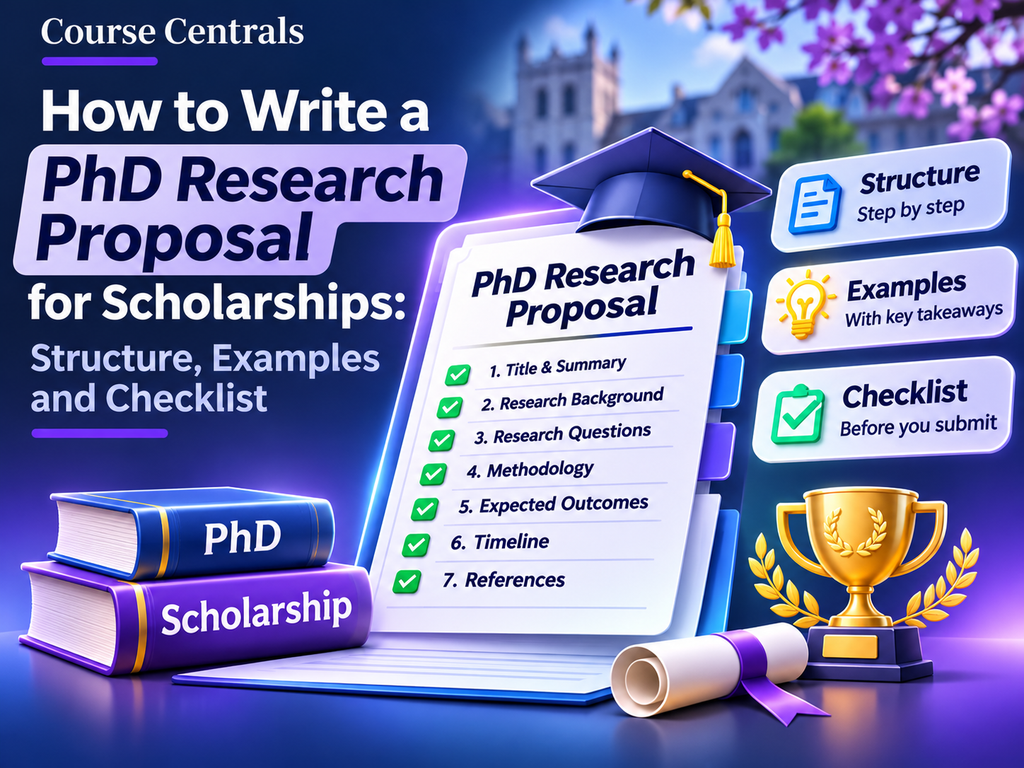
Seven sections to consider in a PhD research proposal
1. Working title and central research question
Use a descriptive title that names the population, phenomenon or setting when appropriate. Turn a broad interest into a question that could realistically be answered with evidence. Rather than “Artificial intelligence in education,” consider “How do first-year university students evaluate AI-generated feedback on academic writing?” This is a hypothetical example, not a pre-approved research topic.
2. Context and the gap in existing knowledge
Summarise the most relevant scholarly work and identify what remains uncertain. Distinguish a genuine research gap from a topic you personally have not read about. Support your argument with actual papers and a current literature search. The University of Cambridge advises applicants to explain how their project fits within the field and why it is important.
3. Aim, objectives and potential contribution
State one overarching aim, followed by two or three concrete objectives. Explain what new understanding, evidence, framework or method your study could contribute. Avoid promising that the findings will prove a preferred conclusion.
4. Methodology and data
Specify the approach, potential data sources, sample or materials, analysis method and why these fit the research question. For qualitative work, this might mean interviews and thematic analysis; for quantitative work, a defined dataset and statistical design. These are examples, not mandatory methods.
5. Feasibility, ethics and risks
Describe access to data or participants, skills you already have, skills you need, realistic milestones and possible ethical approvals. Explain what you will do if recruitment or access is slower than expected. Cambridge explicitly highlights project achievability and, where relevant, ethics and risk.
6. Department and supervisor fit
Identify faculty research interests that genuinely match your proposal, rather than inserting a university name into a generic document. Confirm whether contacting a potential supervisor is required or encouraged. For Imperial’s President’s PhD scheme, the published guidance says applicants must have contacted a supervisor who agrees to supervise the proposed project.
7. References and formatting
Use the required citation style and follow the institution’s document limits. Keep the bibliography accurate and verify every reference. Do not invent citations or claim to have read sources you have not consulted.
Worked hypothetical example: from vague topic to proposal outline
| Element | Illustrative example |
|---|---|
| Broad topic | AI tools and university learning |
| Focused question | How do first-year students interpret AI-generated writing feedback? |
| Research gap to investigate | Whether existing studies sufficiently address student interpretation in a defined setting; verify this through a literature review |
| Possible method | Interviews plus analysis of anonymised feedback examples, subject to ethics approval |
| Potential contribution | Evidence about how feedback is understood and used, without assuming the outcome |
| Feasibility check | Access permissions, participant recruitment, ethics review and time needed for analysis |
Important: This is a structure demonstration. It is not a completed proposal and does not establish that a particular research gap exists.
How long should the proposal be?
Follow the exact course instructions. Limits differ considerably, even within one university. For example, Cambridge’s Faculty of Modern and Medieval Languages and Linguistics advises roughly 500 to 1,000 words for PhD proposals, while Cambridge’s PhD in Education guidance allows up to 1,500 words. Imperial’s President’s PhD Scholarship has a distinct two-page supporting-document format. Do not copy a length requirement from another department.
Common mistakes that weaken scholarship applications
- Submitting the same generic proposal to several universities without showing genuine faculty fit.
- Describing a broad topic but never stating a testable or investigable research question.
- Claiming a research gap without checking recent literature.
- Listing methods without explaining why they answer the question.
- Ignoring word counts, required documents or supervisor-contact rules.
- Inventing sources, citations, findings or previous research experience.
- Confusing scholarship funding criteria with program admission criteria.
Final research proposal checklist
- Confirm whether your course requires a proposal and note its exact word/page limit.
- Write a precise research question and explain its significance.
- Use real literature to justify the problem and potential contribution.
- Match each objective to a suitable method.
- Show a realistic timeline, data access and ethics plan.
- Explain genuine department and supervisor fit.
- Check citations, formatting, filenames and submission instructions.
- Ask a qualified reader to review clarity and feasibility.
Next steps: connect your proposal to scholarship applications
Start by identifying suitable programmes and funding opportunities in our fully funded scholarships guide. For a concrete example of a research-focused scholarship, read our Imperial President’s PhD Scholarship guide and check the official Imperial requirements. If Cambridge is relevant, compare the Gates Cambridge Scholarship guide with the relevant Cambridge course requirements.
Questions applicants often ask
Can I use one proposal for multiple universities?
You can reuse the core research idea, but you must adapt the length, structure, supervisor fit and supporting documents to each programme.
Do I need a supervisor before applying?
It depends on the course and scholarship. Check the official instructions; some schemes require prior contact, while others do not.
Can AI write my research proposal?
Check each university’s AI-use policy. Your research plan, scholarship claims and references must remain accurate and genuinely your own work. Never submit fabricated citations or research experience.
Does a good proposal guarantee scholarship funding?
No. Selection may also consider academic achievement, references, supervisor support, eligibility, funding availability and interviews.
Primary sources and further reading
- Oxford: Research proposal application guidance
- Cambridge: Writing a research proposal
- Cambridge PhD in Education: application requirements
- Imperial: President’s PhD Scholarships
Editorial note: Programme requirements change. Check official sources again immediately before submission.