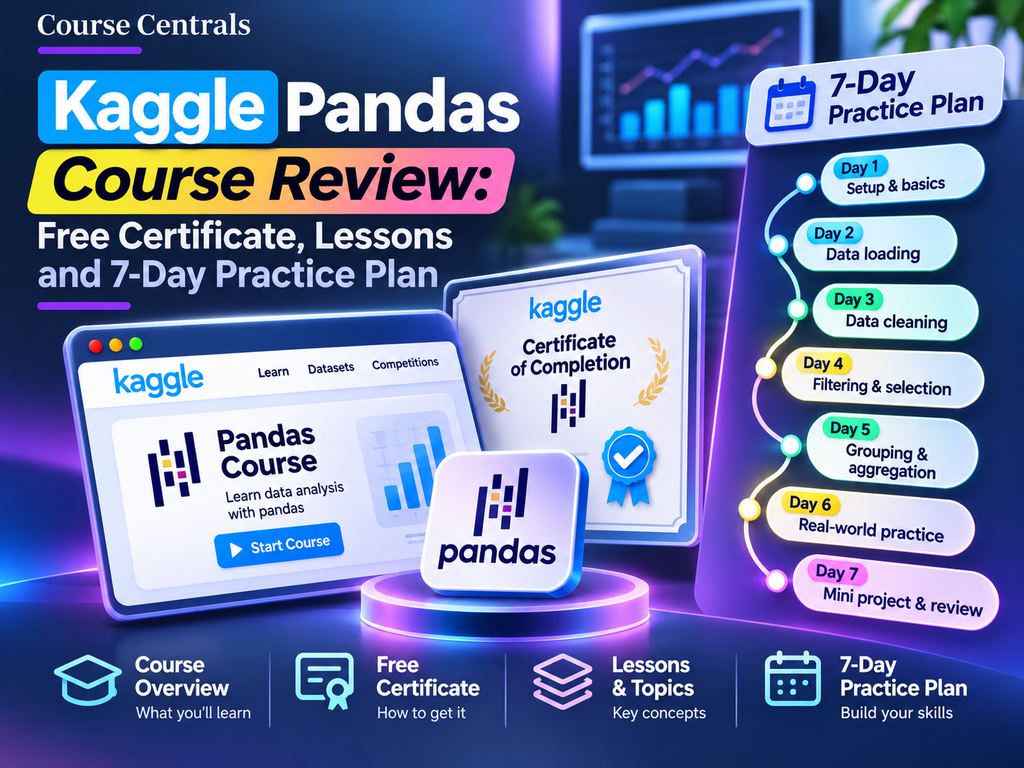
Quick answer: Kaggle Learn’s Pandas course is a free, hands-on introduction to analyzing tabular data with Python. Kaggle lists six lessons and an estimated four hours to earn its course-completion certificate. It is a useful next step after basic Python, but it is not a professional data-analyst certification. Start with the official Kaggle Pandas course.
Course details checked against Kaggle’s official course listing on 30 October 2026. Availability and requirements can change.
Kaggle Pandas course at a glance
| Question | Answer |
|---|---|
| Provider | Kaggle Learn |
| Topic | Python pandas for data manipulation |
| Level | Beginner with basic Python knowledge |
| Estimated duration | 4 hours, according to Kaggle |
| Price | No cost |
| Certificate | Free Kaggle course-completion certificate after completing course requirements |
| Prerequisite path | Kaggle Python is listed as the preceding course |
| Best for | Students and aspiring analysts who want hands-on DataFrame practice |
What will you actually learn?
Pandas is a Python library used to load, select, clean, group and combine structured data. Kaggle’s six short lessons concentrate on the operations you will repeatedly use when exploring a spreadsheet or CSV dataset.
- Creating, Reading and Writing: create DataFrames and load or export data.
- Indexing, Selecting and Assigning: select relevant rows and columns and change values.
- Summary Functions and Maps: calculate descriptive summaries and transform values.
- Grouping and Sorting: aggregate data by category and order results.
- Data Types and Missing Values: inspect types and handle null values.
- Renaming and Combining: rename fields and combine data from multiple sources.
These are practical foundations, not a full statistics, SQL or business-intelligence curriculum. Kaggle itself positions the course after Python and before its Data Cleaning, Geospatial Analysis and Intermediate Machine Learning courses.
Is Kaggle Pandas really free, including the certificate?
Yes, the official listing states that the course costs nothing and gives an estimated four hours to earn the certificate. Kaggle’s learning catalog describes its courses as no-cost and offering signed certificates. This is a course-completion certificate, not an independently proctored industry credential or university degree. You should not present it as equivalent to a professional certification.
If your priority is a job-ready portfolio, use the certificate as a learning milestone, then publish a small project demonstrating your own data cleaning and analysis. If you want a broader comparison, see our best free data analysis courses and certificate options.
Who should take it, and who should start elsewhere?
| Your situation | Recommendation |
|---|---|
| Never coded before | Learn Python basics first. See our free Python course comparison. |
| Know lists, loops and functions | Take Kaggle Pandas now and practice every exercise. |
| Already use Excel extensively | Use pandas to automate repeated spreadsheet operations; compare results with Excel. |
| Need database querying | Study SQL alongside pandas. Our free SQL practice guide provides a structured starting point. |
| Need dashboards for business users | Follow with Microsoft’s Power BI learning path. |
| Need a recognized professional credential | Compare a separate assessed certification after building core skills; Kaggle completion is not a substitute. |
A practical example: from spreadsheet to answer
Suppose you have a CSV containing a country’s scholarship applications, destinations and funding types. With pandas you could group applications by destination and calculate the number of fully funded awards. The following illustrative example uses a small made-up dataset, not actual scholarship statistics:
import pandas as pd
data = pd.DataFrame({
    "destination": ["UK", "Canada", "UK", "Germany"],
    "funding": ["Full", "Partial", "Full", "Full"]
})
summary = (data[data["funding"] == "Full"]
           .groupby("destination")
           .size()
           .sort_values(ascending=False))
print(summary)
This exercise combines filtering, grouping and sorting. It demonstrates the type of repeatable workflow that is harder to audit when performed through manual spreadsheet steps.
Seven-day learning plan: course plus a real project
| Day | Focus | Evidence of learning |
|---|---|---|
| 1 | Refresh Python and read a CSV | Load a sample dataset into a DataFrame |
| 2 | Select and filter records | Answer three filtering questions |
| 3 | Summaries and transformations | Create new columns and descriptive summaries |
| 4 | Group and sort | Rank categories and explain the result |
| 5 | Missing data and types | Document cleaning decisions |
| 6 | Combine datasets | Join two related tables and check row counts |
| 7 | Portfolio mini-project | Publish a notebook with three findings and caveats |
Use a public dataset with a clear license. Include your research question, data source, cleaning decisions, code, findings and limitations. A recruiter should be able to reproduce the result, not just see a screenshot of a chart.
Kaggle Pandas vs free Python and Power BI courses
| Course | Best skill | Free learning | Credential distinction |
|---|---|---|---|
| Kaggle Python | Programming foundations | Yes | Free platform completion certificate |
| Kaggle Pandas | Tabular data manipulation | Yes | Free platform completion certificate |
| Kaggle Data Cleaning | Cleaning messy datasets | Yes | Free platform completion certificate |
| Microsoft Learn Data Analytics | Analytics roles and Power BI | Yes | Learning achievements are distinct from the professional certification exam |
What to learn after Kaggle Pandas
For a data-analyst pathway, add SQL, data cleaning, statistics and a dashboarding tool. Kaggle’s Data Cleaning course builds directly on pandas, while Microsoft Learn provides a separate route into Power BI. For broader planning, use our free data analysis learning roadmap rather than collecting unrelated certificates.
Frequently asked questions
Do I need to install Python?
Kaggle offers browser-based interactive learning. You can start with its hosted course exercises, then learn local installation later if your project requires it.
Can I finish in one day?
Kaggle estimates four hours for the course. Allow extra time to repeat exercises and build a small independent project.
Does the certificate guarantee a data analyst job?
No. It records completion of a short course. Hiring depends on broader skills, projects, communication and the requirements of each role.
Should I learn SQL before pandas?
Either order can work. SQL helps retrieve and aggregate database records; pandas helps analyze and transform data in Python. Many analysts benefit from both.
Final recommendation
Take Kaggle Pandas if you already understand basic Python and want a short, genuinely free way to practice DataFrames. Finish the exercises, complete one portfolio project, and then progress to data cleaning or SQL. For the current course requirements, use Kaggle’s official course page.
Editorial disclosure: This guide is independent educational information. Course Centrals does not claim that the completion certificate is an accredited or professional qualification. No affiliate relationship is claimed for the course links above.