
Quick answer: The best digital marketing course depends on what you want to do next. Beginners should first build broad skills across SEO, content, social media, email, advertising and analytics. Learners targeting a marketing job should then add a structured professional certificate or a specialist credential. This guide maps the strongest learning routes instead of treating every certificate as interchangeable.
If you already know you want a platform-led credential, start with our Meta Social Media Marketing Professional Certificate review. You can also browse our broader Google Professional Certificates guide to compare Google’s job-ready pathways.
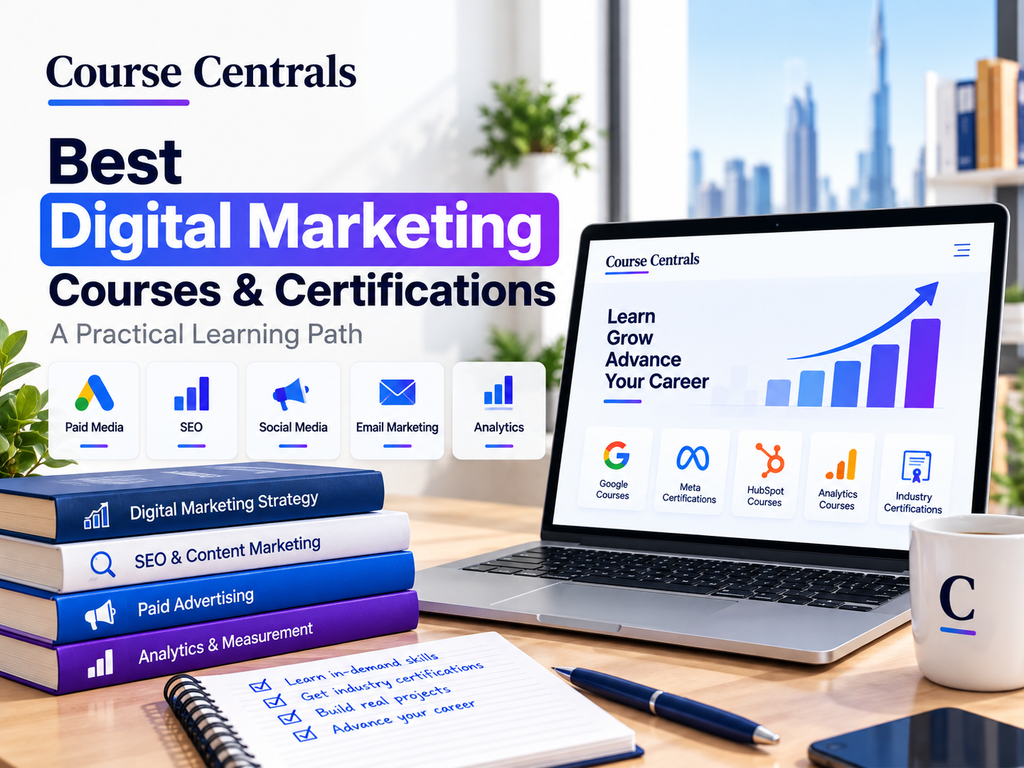
Best digital marketing learning paths at a glance
| Goal | Recommended starting point | Why |
|---|---|---|
| Learn fundamentals free | HubSpot Digital Marketing Certification | Free, broad introduction covering SEO, content, email, social and advertising |
| Build job-ready breadth | Google Digital Marketing & E-commerce Professional Certificate | Structured multi-course pathway covering marketing and e-commerce tools |
| Specialize in social media | Meta Social Media Marketing Professional Certificate | Focused pathway for social strategy, content, advertising and measurement |
| Learn content marketing | HubSpot Content Marketing Certification | Free specialist training in content strategy, creation, promotion and analysis |
| Learn digital advertising | HubSpot Digital Advertising Certification plus platform practice | Useful free foundation before deeper Google Ads or Meta Ads specialization |
1. HubSpot Digital Marketing Certification
Best for: beginners who want a genuinely free starting point.
HubSpot Academy describes its Digital Marketing Certification as a free course covering digital strategy, SEO, content, social media, email and advertising. It is a sensible first step because learners can understand the major channels before committing to a longer paid program.
Course Centrals verdict: Start here if you are new to marketing. A free broad course is more useful at this stage than collecting several narrow certificates without understanding how the channels connect.
1. HubSpot Digital Marketing Certification
Best for: beginners who want a genuinely free starting point.
HubSpot Academy describes its Digital Marketing Certification as a free course covering digital strategy, SEO, content, social media, email and advertising. It is a sensible first step because learners can understand the major channels before committing to a longer paid program.
Course Centrals verdict: Start here if you are new to marketing. A free broad course is more useful at this stage than collecting several narrow certificates without understanding how the channels connect.
1. HubSpot Digital Marketing Certification
Best for: beginners who want a genuinely free starting point.
HubSpot Academy describes its Digital Marketing Certification as a free course covering digital strategy, SEO, content, social media, email and advertising. It is a sensible first step because learners can understand the major channels before committing to a longer paid program.
Course Centrals verdict: Start here if you are new to marketing. A free broad course is more useful at this stage than collecting several narrow certificates without understanding how the channels connect.
2. Google Digital Marketing & E-commerce Professional Certificate
Best for: learners pursuing entry-level digital marketing or e-commerce roles.
Google’s professional certificate is a multi-course career pathway covering digital marketing and e-commerce concepts and tools. The curriculum includes areas such as Google Ads, Google Analytics, customer engagement, email, social media and e-commerce.
This sits naturally alongside Google’s wider career-certificate ecosystem. See our guide to Google courses and professional certificates before choosing a pathway.
3. Meta Social Media Marketing Professional Certificate
Best for: social media marketing and paid-social learners.
The Meta pathway is more specialized than a broad digital marketing course. It is useful when you already know that social strategy, content creation, advertising and campaign measurement are central to your career goal.
Read our full Meta Social Media Marketing certificate review for the curriculum, learner fit and decision factors.
4. HubSpot Content Marketing Certification
Best for: content marketers, SEO-adjacent roles and creators.
HubSpot’s free Content Marketing Certification focuses on building a content strategy, creating and repurposing content, promotion and analysis. It is particularly useful as a specialist layer after learning digital marketing fundamentals.
5. HubSpot Digital Advertising Certification
Best for: learners beginning paid media.
This free certification provides a foundation in digital advertising. Treat it as a starting point rather than the end of paid-media training. Practical campaign experience and platform-specific knowledge remain important for Google Ads and Meta Ads roles.
How to choose a digital marketing course
Choose by career outcome, not brand name
If you want an entry-level marketing role, prioritize broad job-ready skills. If you already work in marketing, a specialist course in SEO, paid media, analytics, email or social media may create more value.
Separate a course certificate from a professional certification
A completion certificate shows that you finished a learning program. It is not automatically the same as a proctored industry certification. Course Centrals distinguishes these credential types so learners can compare them accurately.
Check whether the learning and certificate are both free
“Free course” does not always mean “free certificate.” Some platforms allow free learning but charge for verified credentials. HubSpot Academy explicitly offers several free certification courses, while other providers use audit, subscription or paid-certificate models.
A practical digital marketing roadmap
- Foundation: Learn digital strategy, SEO, content, social, email, advertising and analytics.
- Choose a specialization: SEO, paid media, social media, content, email or analytics.
- Learn the tools: Practice with the platforms employers actually use.
- Build evidence: Create campaigns, audits, dashboards or portfolio projects.
- Add the right credential: Choose a certificate that reinforces your target role rather than collecting unrelated badges.
Frequently asked questions
What is the best digital marketing course for beginners?
A broad introductory course is usually the best first step. HubSpot’s free Digital Marketing Certification is a low-risk starting point, while Google’s professional certificate offers a longer job-oriented pathway.
Can I learn digital marketing for free?
Yes. HubSpot Academy offers free digital marketing training and certifications. Other platforms may provide free course access but charge for certificates, so always check the credential terms.
Which digital marketing certificate is best for jobs?
There is no universal winner. Google’s pathway is broad and career-oriented, Meta is stronger for social-media specialization, and HubSpot provides useful free credentials across inbound, content, email and advertising.
Should I learn SEO or paid ads first?
Beginners benefit from understanding both before specializing. Choose SEO if you prefer organic discovery, content and technical optimization. Choose paid media if you prefer campaign management, audiences, bidding, experimentation and performance measurement.