
Quick Answer: NVIDIA is best known for GPUs, but its learning ecosystem also includes practical training in data science, computer vision and machine learning. If you already understand basic Python and AI concepts, these NVIDIA data science courses and technical resources can help you move into more specialized areas such as GPU-accelerated analytics, video AI, image classification and recommendation systems.
Important: Availability and pricing can change. Some NVIDIA resources are free videos, while instructor-led or hands-on DLI courses may be paid. Always check the official course page before enrolling.
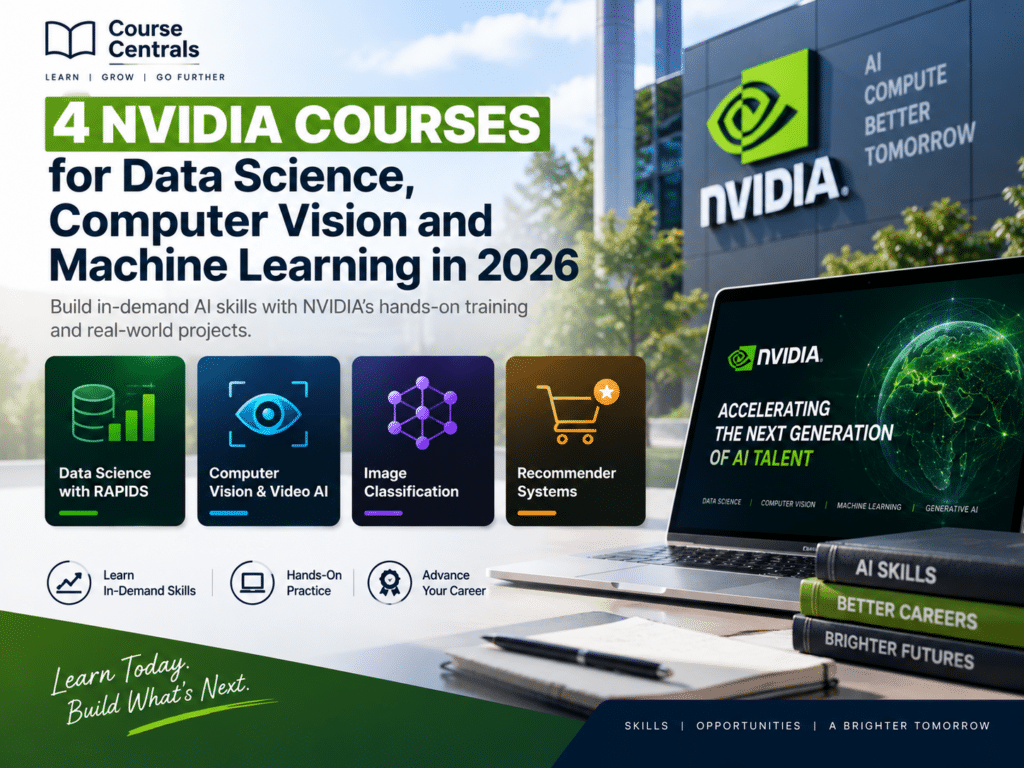
NVIDIA Courses at a Glance
| Course | Best For |
| Accelerate Data Science Workflows With Zero Code Change | GPU-accelerated data science |
| Building Video AI Applications | Video analytics and DeepStream |
| Mastering Recommender Systems | Recommendation engines |
| How to Perform Large-Scale Image Classification | Computer vision |
1. Accelerate Data Science Workflows With Zero Code Changes
Best for: Data scientists working with Python-based analytics
This NVIDIA training focuses on using RAPIDS to accelerate data science workflows that would normally run on CPUs. It is particularly relevant if you already work with tabular data and common Python analytics libraries and want to understand how GPU acceleration can improve demanding workflows.
NVIDIA lists basic data-processing knowledge and familiarity with standard Python data-science workflows as useful prerequisites. This makes it better suited to learners who already understand the fundamentals rather than complete beginners.
COURSERA ALTERNATIVE
For learners who need broader foundations first, explore Coursera’s data-science and machine-learning catalog:
2. Building Video AI Applications
Best for: Developers interested in computer vision and intelligent video analytics
Building Video AI Applications moves beyond static datasets into real-time video. The training introduces NVIDIA’s video AI ecosystem and the type of workflows used to analyze and annotate video streams.
This is a more specialized option than a general computer vision course. It makes the most sense for developers interested in applications such as smart cameras, retail analytics, industrial monitoring and other real-time vision systems.
COURSERA ALTERNATIVE
Explore computer vision courses on Coursera:
3. Mastering Recommender Systems
Best for: Data scientists and ML learners interested in personalization
This NVIDIA Grandmaster Series session examines techniques used by NVIDIA Kaggle Grandmasters in an e-commerce recommendation competition. Topics include candidate generation, co-visitation matrices, reranking, feature engineering and model ensembling.
The biggest advantage is its practical competition perspective. Instead of functioning as a complete beginner course, it shows how experienced practitioners approach recommendation problems.
COURSERA ALTERNATIVE
Coursera alternative: Recommender Systems, Sungkyunkwan University
https://www.coursera.org/learn/recommender-systems-ml
For a deeper learning path, Coursera also offers the University of Minnesota’s Recommender Systems Specialization:
https://www.coursera.org/specializations/recommender-systems
4. How to Perform Large-Scale Image Classification
Best for: Computer vision and Kaggle learners
This NVIDIA Grandmaster Series resource looks at the Google Landmark Recognition competition, where models had to work across more than 81,000 classes. It covers competition strategy, validation, model architecture, fine-tuning, post-processing and ensembles.
It is particularly useful because large-scale classification introduces challenges that are easy to miss in beginner computer vision tutorials.
COURSERA ALTERNATIVE
Explore image classification and computer vision courses on Coursera:
Which NVIDIA AI Course Should You Take First?
- Choose Accelerate Data Science Workflows if you already work with Python and want to understand GPU-accelerated data science.
- Choose Building Video AI Applications if you want to build applications around real-time video and computer vision.
- Choose Mastering Recommender Systems if you are interested in personalization, ranking and recommendation engines.
- Choose Large-Scale Image Classification if you want to study advanced computer vision and learn from competition-level approaches.
Are NVIDIA AI Courses Worth It?
Yes, particularly as specialist learning resources rather than replacements for a complete data science or machine learning curriculum.
The strongest advantage is access to technical topics connected to NVIDIA’s ecosystem and real-world accelerated computing. However, learners should distinguish between free NVIDIA videos and NVIDIA Deep Learning Institute training that may have enrollment fees.
If you are new to AI, start with our guide to NVIDIA AI courses for Generative AI, RAG and AI agents before moving into these more specialized topics.
Frequently Asked Questions
Does NVIDIA offer data science courses?
Yes. NVIDIA’s training ecosystem includes data science education covering accelerated Python workflows, RAPIDS, GPU computing and related AI technologies.
Are NVIDIA data science courses free?
Some NVIDIA learning resources and developer videos are free, while other Deep Learning Institute courses and workshops are paid. Check the current NVIDIA course page before enrolling.
What is NVIDIA RAPIDS?
RAPIDS is a collection of GPU-accelerated open-source libraries designed to speed up data science and analytics workflows using NVIDIA GPUs.
Which NVIDIA course is best for computer vision?
For learners interested in real-time video analytics, Building Video AI Applications is the most directly relevant option in this list. The Large-Scale Image Classification Grandmaster session is better for learners interested in advanced image-classification strategies.